
Painesville City Directory Collections
Morley Library is the main local custodian for Painesville city directories. Its second-floor Genealogy & Local History Room is appointment only during regular library hours, and requests go to Morley Library Genealogy and Local History. The shelf is useful because its holdings are identified by edition, not described as one continuous run. Read the title and geography on every volume. Later editions may cover Painesville alongside nearby communities, so a listed address or name needs the edition date and coverage label beside it.
| Collection | Years | Where Held | Access |
|---|---|---|---|
| Painesville city directories | 1895, 1902, 1906, 1908, 1911, 1923, 1929, 1930 | Morley Genealogy & Local History Room | Appointment consultation |
| Expanded Painesville-area editions | 1940, 1942, 1954, 1961, 1962, 1964, 1965, 1966-1990, 2000-present | Morley Library | Room consultation; current subscription continues |
| Haines & Co. Lake-Geauga Criss-Cross | 1976, 1977, 1981-1987, 1989, 1991-present | Morley Library | Address-to-printed-name volumes; stated gaps |
| Digitized and transcribed Painesville materials | 1895, 1902, 1906-07, 1907, 1929, 1930 | Lake County genealogy project and Morley originals | Finding aid or online transcription; check the original when needed |
The gaps matter. No held year proves what happened in the years between it and the next volume. The library's list also shows changing place names, from Painesville alone to wider Painesville-Mentor and multi-community editions. That change can be useful for a family moving nearby, but it should never be treated as proof that every household was covered.
Morley Library's directory-holdings page identifies the individual Painesville and Haines runs used for this work.
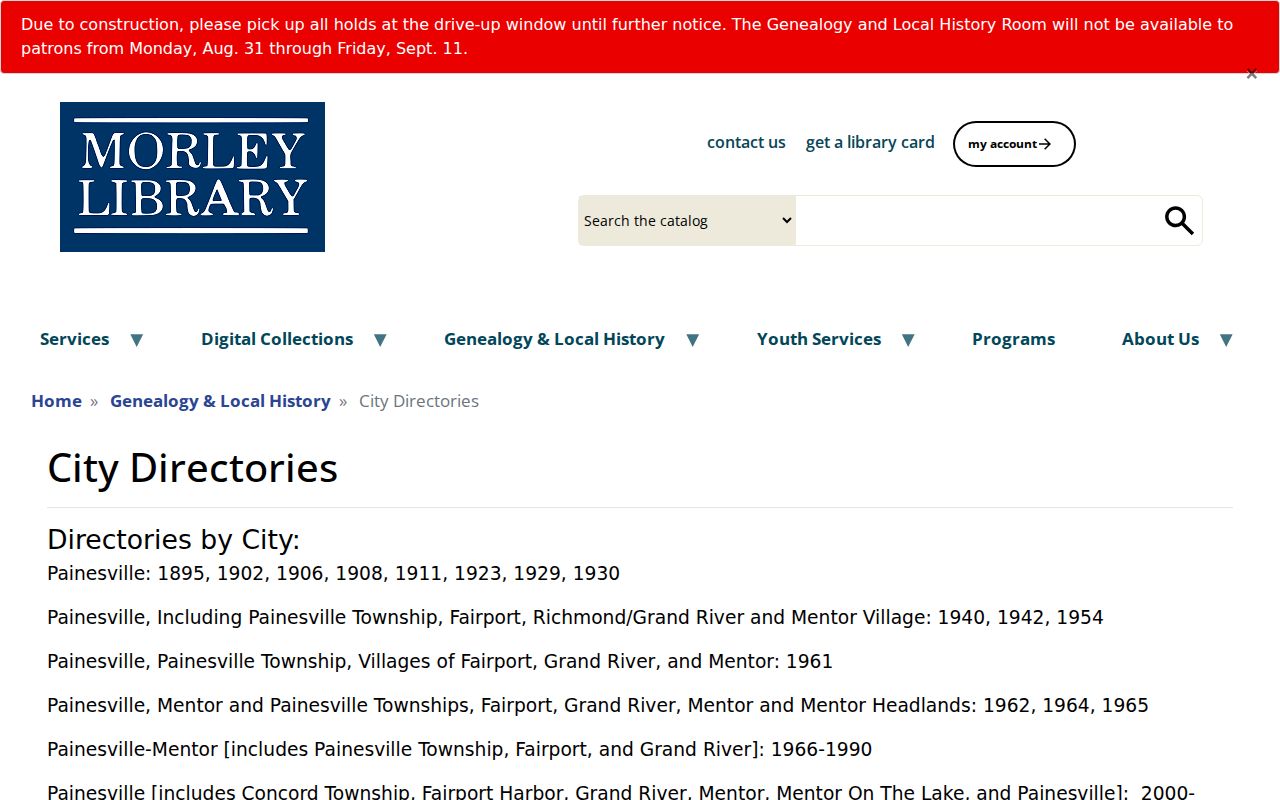
Use the holdings list to select an actual volume near the date in question instead of assuming an annual Painesville city directory survives.
Painesville Directory Room Access
Morley is more than a directory shelf. The room also holds newspapers, obituaries, yearbooks, atlases, census help, church and cemetery material, naturalization material, telephone books, marriage and will resources, and local histories. Make an appointment before visiting, and include the surname, address, period, or volume sought in an email to genealogy@morleylibrary.org. The library says there are no genealogy or local-history researchers on staff, and its posted response expectation for genealogy requests is three to five business days.
That access model makes a focused request more productive. Ask whether a named volume is available, whether the title has a street portion, and whether an index or microfilm source is held. A request for an obituary can be made by email, phone, or mail. Morley asks for a full decedent name, death date, publication date if known, and paper or electronic preference. The research record supports a limit of up to four obituary requests at a time unless staff directs otherwise.
Morley's Genealogy & Local History Room page explains the appointment route and access conditions.
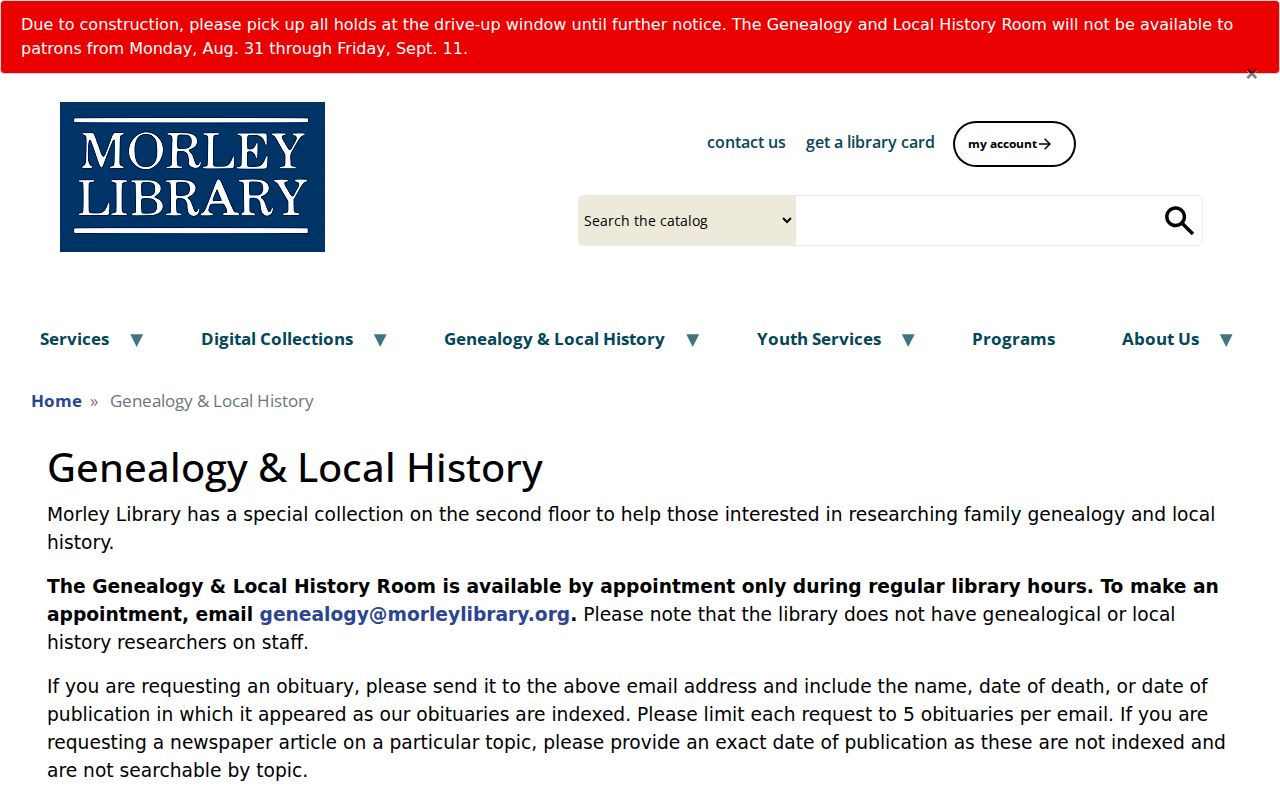
Directory research works best when the selected edition, page or section, and original printed spelling are recorded with the result.
Painesville Directory Street Lists
The 1923 Painesville volume is the first Morley holding specifically identified as having a street-address listing. Before that point, begin with the name portion of the directory and preserve the printed address if one appears. Do not assume an early volume can be searched from a modern street number. Street names, municipal coverage, and numbering can differ across time, and no citywide Painesville renumbering crosswalk was established in the local research.
The Lake County genealogical project describes the 1895 Painesville General Directory as the oldest known extant Painesville directory. It also describes the 1906-07 Painesville City Directory as a 129-page volume with 3,650 citizen entries and 715 classified-business entries, plus local history and street, school, and church material. A four-page 1907 Painesville Telephone Company directory lists residents and businesses. Those descriptions guide a search, but the original at Morley remains the primary record when the exact printed detail matters.
- 1895: the Lake County genealogy project identifies the General Directory as the oldest known extant Painesville directory.
- 1906-07: the described city directory combines citizens, classified businesses, and local street, school, and church material.
- 1923: Morley identifies this held Painesville volume as the first with a street-address listing.
- 1976 onward: available Haines criss-cross volumes introduce an address-to-printed-name route, with documented breaks.
- 2000 onward: Morley's continuing directory subscription covers a wider Painesville-area geography.
The Lake County genealogy project's directory index provides descriptions of the transcribed and digitized Painesville material.
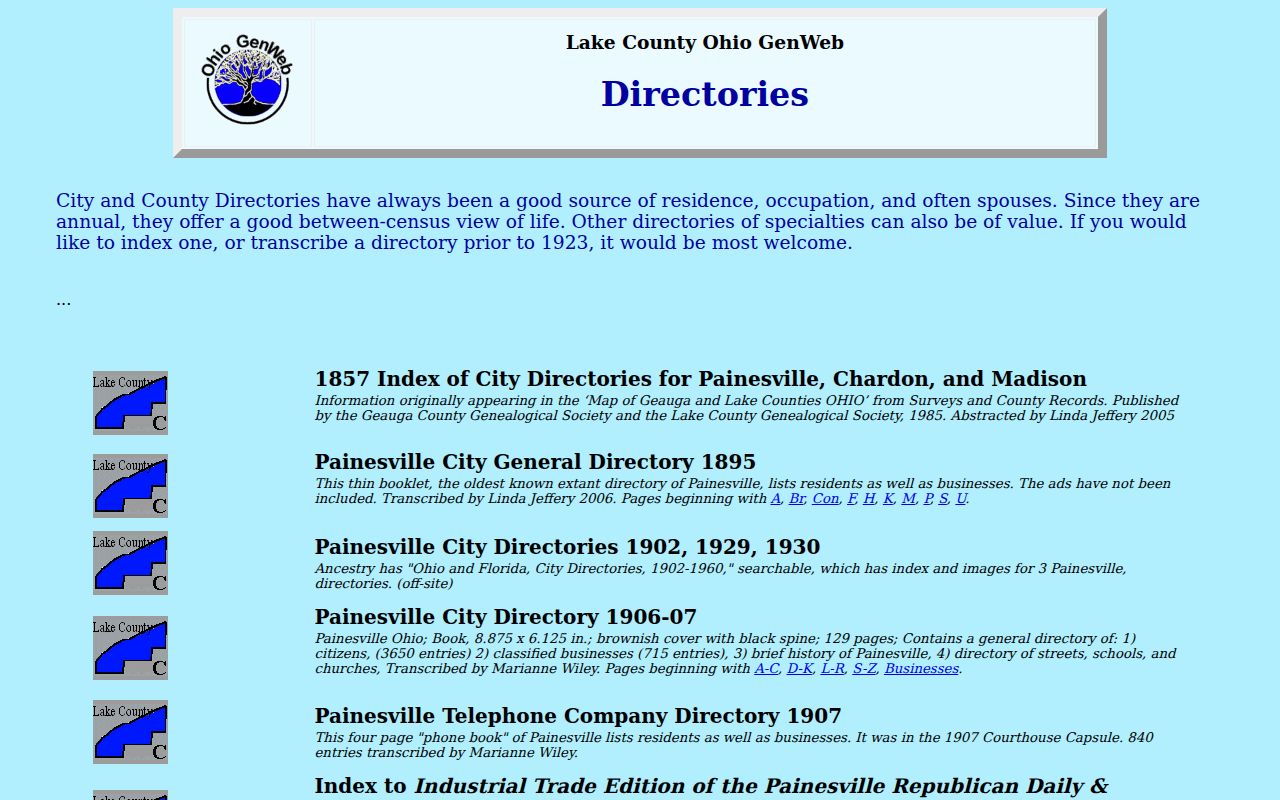
The digitized descriptions help identify a likely edition, while the title page and the physical or original source settle what the volume actually says.
Painesville Criss-Cross Directories
A criss-cross directory reverses the normal question. Instead of beginning with a person and locating a printed address, it arranges an available address section to find the printed name associated with that address. Morley's Haines & Co. Lake-Geauga holdings are available for 1976, 1977, 1981 through 1987, 1989, and a continuing subscription from 1991. They are the local address-to-name route for the listed years, not a continuous record of every year.
For 1978, 1988, or 1990, compare the closest held Haines years and the name side of nearby directories. A result is a dated directory listing, not proof of every person in a household or of a current address. Check geographic labels carefully because Painesville, Painesville Township, Fairport, Grand River, Mentor, and other nearby areas appear in later edition descriptions.
- Criss-cross directory
- A reverse directory arranged to let an address lead to a printed name in the volume.
- Personal-name section
- The part arranged by name. It is the starting point when an early volume lacks a stated street list.
- Abbreviation key
- The volume's own explanation of initials or marks. Read it before assigning meaning to any shorthand.
Lake County Genealogical Society is another local bridge to Morley holdings and original naturalization sources.
When a directory listing produces a name variant, LCGS can point researchers toward the local genealogy and original-record channels rather than treating the listing as a final identity match.
Reading Painesville City Directory Entries
The available official and local collection descriptions do not supply a universal field-by-field key for a personally identifying Painesville entry. That limit is important. A sound transcription records only what the selected volume visibly prints: the name, initials, printed address, section heading, and any abbreviation that the volume itself defines. Do not add a relationship, occupation, ownership status, or other detail unless it appears and its key has been read.
| Printed name | Copy the spelling and initials exactly, then note any variation in the next held issue. |
|---|---|
| Printed address | Keep the address in the volume's form. It may not match a modern street format. |
| Section or arrangement | Record whether the result came from a general citizens list, street list, telephone list, or criss-cross portion. |
| Abbreviations | Use only the title-page or abbreviation key for that same edition. The research does not establish a universal local key. |
| Edition details | Save the directory year, title, geography, and page reference so another reader can check the entry. |
A name absent from one city directory can reflect a gap in holdings, changed coverage, a different printed form, a move, or a choice not to be listed. It does not settle the question on its own.
Painesville Directory Household Tracing
Household tracing through a Painesville city directory is most reliable when each edition is treated as a dated snapshot. Begin with the volume nearest a known event or address. Then move to the previous and next held editions, not to imagined annual volumes. This preserves the missing-year problem instead of hiding it.
- Select the held directory nearest the known name, address, or date, and copy the spelling and printed address exactly.
- Compare the previous and next held Painesville or area edition. Note the edition's geographic title before interpreting an apparent move.
- After 1923, test the street-address listing when the address is known. For available Haines years, use the criss-cross portion as a separate dated check.
- Pair the directory interval with the federal census available for that period. As of 2026, 1950 is the latest released decennial federal census.
- Use a deed, obituary, cemetery, probate, or map record to test the timing and distinguish people with similar names.
Federal census schedules can add household composition at their ten-year dates. They do not fill every directory gap. The better conclusion names the source date for each fact and separates a person listed at an address from every other person who may have been present.
Painesville Directory Obituary Checks
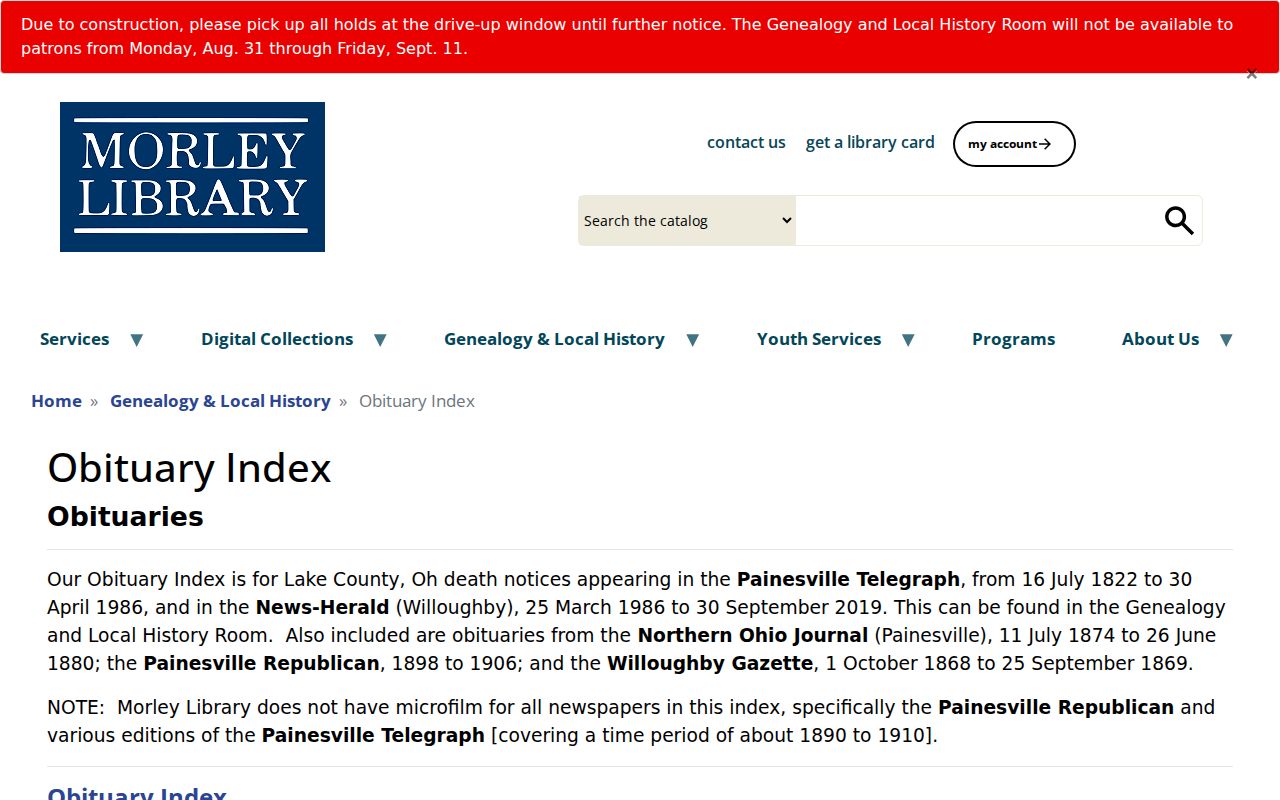
Morley's obituary index can test a disappearance from a directory or add a newspaper date to a family trail. Its Painesville Telegraph notices run from July 16, 1822 through April 30, 1986. The index also identifies Northern Ohio Journal notices from 1874 to 1880, Painesville Republican notices from 1898 to 1906, Willoughby Gazette notices from 1868 to 1869, and News-Herald notices from March 25, 1986 through September 30, 2019.
An index hit is not automatically a readable obituary. Morley warns that it lacks microfilm for all indexed items, including Painesville Republican material and some Painesville Telegraph editions around 1890 through 1910. Preserve the newspaper title and date, then ask whether Morley can supply it or whether another repository must be used.
Morley's obituary-index page describes the named newspaper runs and request route.
Used alongside a dated directory listing, an obituary index can supply a publication lead without replacing a vital or probate record.
Painesville Directory Map Context
Maps and historical collections help test whether a printed address fits the same property over time. The Library of Congress Painesville Sanborn map is an August 1904 set of 18 sheets. It can show street names, building footprints, lot context, and block layout, but it does not name a household. Morley also lists indexed Lake County atlases from 1840 and 1857. Pair map evidence with a legal description or a dated directory entry rather than assuming a current number existed on the map.
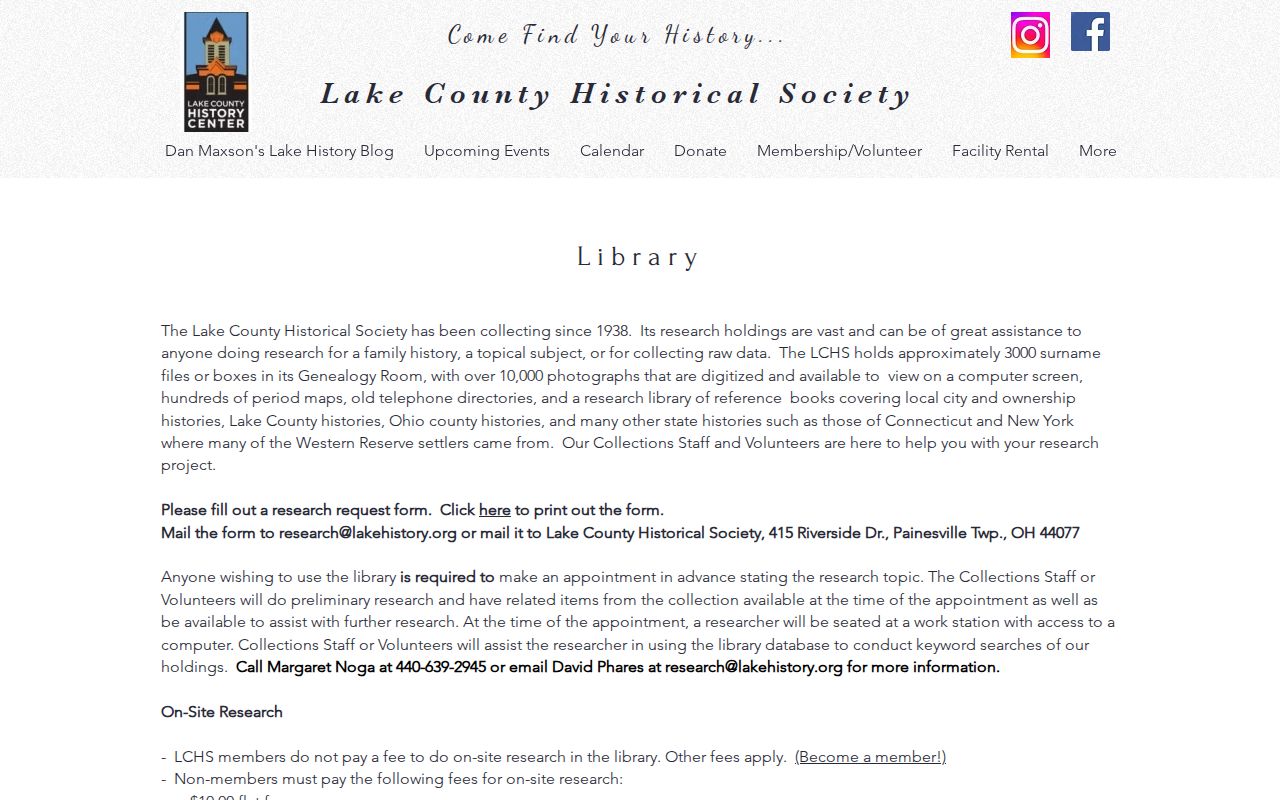
The Lake County Historical Society and History Center adds a different local path: about 3,000 surname files or boxes, more than 10,000 digitized photographs viewable on site, hundreds of period maps, old telephone directories, and ownership-history references. Advance appointment is required so staff can prepare material for the stated topic. Its posted on-site adult nonmember research fee is $10, and remote staff research is listed at $25 per hour.
The History Center research library describes appointments, local holdings, and its published research options.
Those holdings are a useful fallback when a directory year is absent or an older street form needs map and ownership context.
Painesville Directory Evidence Limits
A city directory is a printed, dated source with real strengths and real boundaries. It can preserve a name or address in a particular edition. It cannot prove an uninterrupted residence, a complete household, a legal boundary, or the present status of any person. Property, map, court, cemetery, and historical custodians each keep different record types, and a match in one system should be checked against another source with a different purpose.
For early land work, Lake County was created from Geauga County in 1840, and the Lake County Recorder's first deed is dated April 16, 1840. The online Recorder index begins in 1986 and images in 1990, so a deeper property connection requires the Records Room or another documented access channel. Note: Missing material should be treated as a coverage or custody question, not as proof that a record was destroyed.